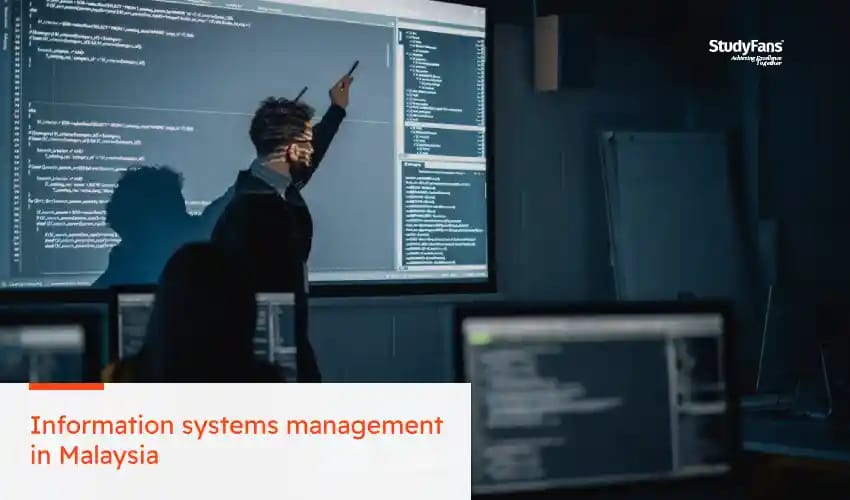

With the world moving toward digitalization, the success of any organization now depends on the proper management of its information systems, creating a strong market demand for information systems management.
The information systems management major in Malaysia combines computer science and business, offering its students an unlimited number of career fields and opportunities. Malaysia is distinguished by its development and interest in technological specializations.
If you want to study in a technological environment and learn using modern and advanced methods, then you should study information systems management in Malaysia.
About the Information Systems Management in Malaysia
The Information Systems Management major is a field of study that combines information technology and business administration with the goal of improving organizational performance through efficient and effective information management.
This major focuses on designing, implementing, and managing information systems that support administrative processes and decision-making within organizations.
Information Systems Management in Malaysia covers a variety of topics, including:
Information Systems Analysis and Design: Studying how to analyze business requirements and design systems that meet those requirements.
Database Administration: Learning how to create and manage large databases that store corporate data.
Cybersecurity: Studying how to protect information and systems from cyber threats.
E-commerce: Understand how to manage online businesses.
Technical Project Management: Learn how to plan, implement, and monitor technical projects.
Why study Information Systems Management in Malaysia?
Studying Information Systems Management in Malaysia provides students with the opportunity to gain in-depth knowledge in a vital and growing field, while benefiting from a distinguished educational environment and extensive career opportunities.
Malaysia is therefore a prime destination for studying Management Information Systems for several reasons, including:
Educational Quality: Malaysian universities are renowned for offering high-quality academic programs in information systems management. Many Malaysian universities are also ranked among the best in Asia and the world.
Cultural Diversity: Malaysia is a multicultural society, providing students with the opportunity to interact with different cultures. This interaction enhances communication skills and cultural understanding.
Innovation and Technology: Malaysia is a hub for technology and innovation in Asia, providing students with opportunities to learn about the latest technological developments and participate in innovative technology projects.
Reasonable cost of living: Compared to many Western countries, the cost of living in Malaysia is very reasonable, and tuition fees at Malaysian universities are also average. This makes studying in Malaysia an economical option for international students seeking high-quality education at an affordable cost.
English: English is the primary language of instruction at most Malaysian universities, and English language study in Malaysia is available at many universities and institutes.
International Recognition: Degrees issued by Malaysian universities are recognized globally, allowing graduates to work anywhere in the world.
Employment Opportunities: The Malaysian job market is open to qualified graduates in the field of information systems management, providing good employment opportunities after graduation.
What are the study materials for the Information Systems Management major in Malaysia?
Studying in Malaysia attracts many international students from all over the world, as it offers a variety of world-class specializations.
The Information Systems Management major at Malaysian universities includes a variety of study subjects that aim to equip students with the skills and knowledge necessary to design and manage information systems efficiently.
Here is a list of some of the core subjects studied in information systems management in Malaysia:
Introduction to Information Systems: (Basic concepts in information systems, the role of information systems in organizations).
Cybersecurity and Risk Management: (Cybersecurity principles, risk management strategies, and data security).
Information Systems Analysis and Design: (Systems analysis techniques and methods, information systems design using modern tools).
E-commerce and E-Business Management: (E-business models, e-commerce technologies and applications).
Database Administration: (Database design and management, data query languages such as SQL).
Technical Project Management: (Project management principles, project planning and implementation tools and techniques).
Decision Support Systems: (Applications of decision support systems in business, modeling and analysis using advanced tools).
Management Information Systems: (Management of information resources in organizations, integration between information systems and management).
Web Application Development: (Web application development techniques, website management and optimization).
Artificial Intelligence and Data Analytics: (Applications of artificial intelligence in information systems, big data analysis, and extracting valuable information).
These courses provide students with the comprehensive knowledge and practical skills necessary to succeed in the field of information systems management.
The curricula are also regularly updated to keep pace with rapid developments in information technology and market needs.
Future Careers for Information Systems Management Graduates in Malaysia
Information Systems Management graduates in Malaysia enjoy diverse career opportunities due to the growing demand for technical and managerial skills in various industries.
The following are some of the future careers that Information Systems Management graduates in Malaysia can pursue:
1.Information Systems Manager:
Responsible for:
Leading and directing IT teams within organizations.
Developing and implementing information systems strategies to support organizational goals.
2.Information Systems Analyst:
Responsible for:
Analyzing and assessing business needs and designing appropriate information systems.
Improving the efficiency of existing information systems and ensuring they meet technical and administrative requirements.
3.IT Project Manager:
Responsible for:
Planning, implementing, and managing IT projects from start to finish.
Ensuring projects are delivered on time and within budget.
4.Database Engineer:
Responsible for:
Designing and managing large, enterprise databases.
Ensuring data integrity, security, and rapid retrieval.
5.Security Analyst:
Their role is to:
Assess and manage cybersecurity risks.
Develop and implement security policies and procedures to protect sensitive information
6.Web Application Developer:
Their role is summarized as:
Designing, developing, and maintaining web applications.
Improving user experience and ensuring efficient application performance.
7.E-Commerce Manager:
Their role is summarized as:
Managing e-commerce operations, including websites and online platforms.
Improving the performance and effectiveness of online business activities.
8.Data Analyst:
Their role is summarized as:
Collecting and analyzing data to extract valuable information to support management decisions.
Using data analysis tools and reports to provide strategic insights.
9.IT Consultant:
Responsible for:
Providing technical advice and solutions to organizations to improve their information systems and technical infrastructure.
Implementing IT strategies that meet business needs.
10. Technical Support Specialist:
Responsible for:
Providing technical support to users to resolve technical issues.
Maintaining and repairing hardware and software to ensure smooth operation.
11.Network Administrator:
Their role is summarized as:
Managing and maintaining computer networks in organizations.
Ensuring network security and the speed and efficiency of communications.
12.IT Business Analyst:
Their role is summarized as:
Analyzing business requirements and providing technical solutions to improve operations and performance.
Coordinating between technical and administrative teams to ensure the achievement of shared goals.
Top 5 Universities to Study Information Systems Management in Malaysia
Malaysia is one of the best educational destinations in Asia, with many internationally recognized universities offering distinguished programs in information systems management.
Here is a list of the top five universities to study information systems management in Malaysia:
University of Malaya (UM): The University of Malaya is one of Malaysia's oldest and most prestigious universities and holds a prominent position in international rankings. The university offers a comprehensive program in information systems management that focuses on practical application and research.
Universiti Putra Malaysia (UPM): Known for its strong programs in technology and engineering, UPM's Information Systems Management program combines theoretical knowledge with practical skills required for the job market.
Universiti Sains Malaysia (USM): Focusing on innovation and research in science and technology, USM offers a distinguished program in Information Systems Management with diverse research and training opportunities.
Universiti Teknologi Malaysia (UTM): UTM is a leading university in engineering and technology.It also offers an advanced program in Information Systems Management that focuses on innovative technical solutions and practical application.
International Islamic University Malaysia (IIUM): The International Islamic University Malaysia offers a robust program in Information Systems Management that combines Islamic values with technical knowledge. The university boasts a multicultural learning environment and excellent academic support.
The cost of studying information systems management in Malaysia
Study costs in Malaysia vary depending on the major and degree the student wishes to obtain, as well as the university at which the student will study.
Here are the costs of studying information systems management at Malaysian universities:
University | Major | Tuition Fee (MYR) |
City University | Information Technology | 46250 |
MMU University | Computer Science in the following specializations: (Software Engineering, Game Development, Data Science, Cybersecurity) | 83150 |
MMU University | Computer Science (Artificial Intelligence) | 83150 |
MMU University | Information Technology (Information Systems) | 83150 |
MSU University | Information and Communication Technology | 79684 |
INTI University | Computer Science | 90560 |
INTI University | Information Technology | 89688 |
UPM University | Computer Science | 68850 |
Uniten University | Computer Science (Cybersecurity) | 75750 |
Uniten University | Information Technology (Information Systems) | 75750 |
University of Lincoln | Computer Science (Artificial Intelligence) | $22,406 |
IIUM University | Information Technology | 77699 |
UM University | Computer Science (Information Systems) | 68700 |
UTP University | Information Systems | 100200 |
Taylor's University | Information Technology | 117647 |
Alfa University | Information Technology | 46800 |
Benefits of applying through Study Fans to study information systems management in Malaysia
Study Fans offers several benefits when applying to study various majors in Malaysia, including information systems management.
It provides you with the following services:
The ability to apply and obtain university admission without paying any additional fees.
Airport reception and safe housing for students.
Providing all necessary educational consultations for students from around the world.
Providing an integrated information system on various majors in both private and public universities.
If you wanted to know more or have any questions, we are here to help you and you can always contact us:
Phone: 00905437394024
Or via WhatsApp through this link.

![The Top 10 Universities in Türkiye [Worldwide Ranking]](/_next/image?url=https%3A%2F%2Fbackend.studyfans.com%2Fstorage%2Fmedia%2FPostTranslations%2Fimage%2F882%2FE7WXOQMpNbUZMo5P8Bjvt5WqhQPkmpvd2ajkM1JQ.webp&w=1080&q=75)