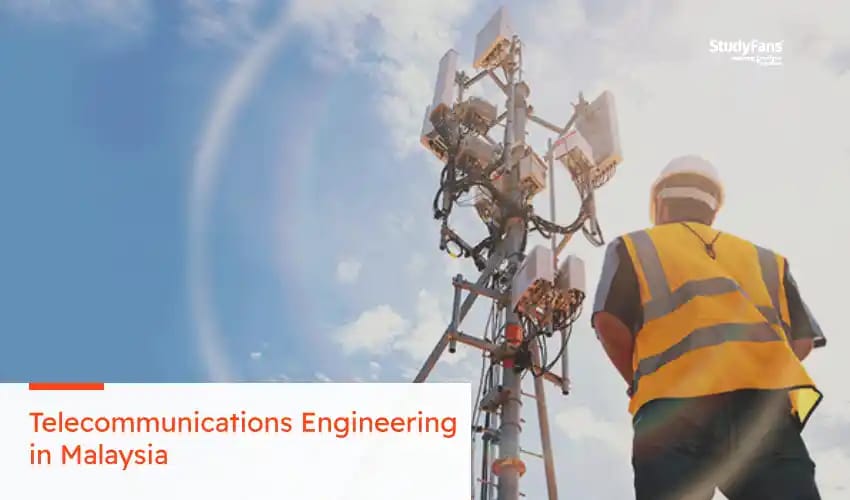

Studying telecommunications engineering in Malaysia has become one of the top choices for international students seeking studying in Malaysia with high-quality engineering education at affordable costs. Malaysian universities combine globally recognized academic standards, modern telecommunications technology, and strong industry-focused training, making Malaysia a leading destination for future telecom engineers.
Major Data | Details |
Academic degree | Bachelor’s, Master’s, PhD |
Duration of study | 4 years |
Average annual cost | $3,400-$6,000 |
Language of study | English |
Best universities |
|
Why Study Telecommunications Engineering in Malaysia?
Malaysia is considered a leading destination for studying telecommunications engineering for the following reasons:
International Academic Standards
Malaysian universities offer updated engineering curricula that match global industry developments in communication systems, networking, and digital technologies. Some universities also provide dual award degrees in partnership with British or Australian institutions.
Affordable Study Costs
Compared to countries such as the UK and Australia, Malaysia offers lower tuition fees and living expenses while maintaining high educational standards. This allows students to receive quality engineering education at a more affordable cost.
Practical Learning Environment
Telecommunications engineering programs in Malaysia include practical training through modern laboratories, networking equipment, simulation software, and internship opportunities with technology and telecommunications companies.
Comparison Between Telecommunications Engineering and Related Specializations
Before choosing your academic path, it is important to understand the differences between telecommunications engineering and other closely related engineering fields. Each specialization focuses on different technologies, career paths, and technical skills.
Telecommunications Engineering vs. Electrical Engineering
Telecommunications engineering mainly focuses on communication systems, wireless networks, signal transmission, fiber optics, satellite communication, and modern networking technologies.
Electrical engineering covers a broader area that includes power systems, electronics, circuits, energy distribution, and industrial electrical applications.
Students interested in internet infrastructure, mobile networks, and digital communication technologies usually prefer telecommunications engineering, while electrical engineering is more suitable for students interested in power generation and electrical systems.
Telecommunications Engineering vs. Computer Engineering
Telecommunications engineering focuses on communication networks and data transmission technologies.
Computer engineering combines computer hardware, software systems, programming, and embedded technologies.
Best Universities to Study Telecommunications Engineering in Malaysia
There are several Malaysian universities that offer internationally accredited engineering programs, including:
University | Ranking | University type | Average annual fees | Link |
#1001–1200 band of the Times Higher Education (THE) World University Rankings 2026 | Private | $6,000 | ||
#791–800 in the QS World University Rankings | Private | $5,700 | https://study.utar.edu.my/telecommunications-engineering.php | |
Public | $3,400 |
Note: Tuition fees are approximate and may change. For the most accurate and updated amount based on today’s exchange rate, please contact us directly on WhatsApp.
Admission Requirements for Telecommunications Engineering in Malaysia
Admission requirements for the telecommunications engineering program in Malaysia are generally set by Malaysian universities in line with international engineering standards and accreditation bodies such as MQA. While requirements may vary slightly between universities, the core conditions remain similar across most institutions.
Academic Qualification
Completion of high school or equivalent qualification (science stream preferred).
Minimum average of 60% – 75% depending on the university.
A strong background in mathematics and physics is usually required.
English Language Requirement
IELTS: 5.5 – 6.5 (depending on the university).
TOEFL: equivalent score accepted by the institution.
Note: Students who don’t meet English requirements may receive a conditional offer and enroll in an English preparatory program before starting the degree.
Additional Requirements
Some universities may require an interview (especially private institutions or scholarship applicants).
In rare cases, a basic assessment or placement test may be required.
No portfolio is needed for telecommunications engineering programs.
Foundation Pathway Option:
If your high school grades don’t meet direct entry requirements, you can join a foundation in the Engineering program, which is offered by most Malaysian universities. This pathway prepares students in mathematics, physics, and basic engineering subjects before progressing into the bachelor’s degree.
Costs of Studying Telecommunications Engineering in Malaysia and Living Expenses
Studying Telecommunications Engineering major in Malaysia is considered affordable compared to many other countries, while offering strong academic quality and modern facilities. Below is a simple brief of the main costs:
Registration fees and student visa (one-time payment):
It is usually around $700 – $1200, depending on the university and application process.
Tuition fees (per year): vary based on the university type and program as mentioned in the university table above.
Accommodation and living costs (monthly):
Most students spend approximately $400 – $700 per month, covering rent, food, transportation, and daily expenses.
Read About: Study fees in Malaysia in English
Is a Telecommunications Engineering Degree from Malaysia Recognized?
The telecommunications engineering degree from Malaysian universities is widely recognized due to Malaysia’s strong national accreditation system and international engineering agreements. Recognition is based on official frameworks issued by Malaysian and global engineering authorities.
Local accreditation:
All engineering programs in Malaysia are regulated by the Malaysian Qualifications Agency (MQA), which ensures academic quality and program standards across universities.
International recognition:
Many engineering programs in Malaysia are also aligned with the Washington Accord, an international agreement that recognizes accredited engineering degrees across member countries such as the United States, United Kingdom, Australia, and Canada. Some Malaysian universities offer dual-degree partnerships with UK or Australian universities, allowing students to graduate with an additional internationally recognized qualification, which strengthens global employability.
Arab country recognition:
Malaysian degrees are accepted in several Arab countries such as Saudi Arabia, Kuwait, Egypt, Jordan, the United Arab Emirates, and Oman, but recognition depends on the specific university and is updated regularly by each country’s ministry of higher education.
Career Opportunities for Telecommunications Engineering Graduates
Graduates of telecommunications engineering in Malaysia are in demand globally due to the expansion of modern communication networks.
Career Prospects:
Network Engineer
Transmission Engineer
Core Network Engineer
Test Engineer
Embedded Software Engineer
IoT Engineer
Data Centre Engineer
Radio Frequency (RF) Engineer
Wireless Communication Engineer
Broadcast Engineer
RF Design Engineer
Embedded Systems Engineer
Mobile Application Developer
Telecommunications Equipment Engineer
Project Manager (Telecom Industry)
Technical Sales Engineer
Average salary:
The average monthly salary for a telecommunications engineer in Malaysia is approximately RM 5,900.
Conclusion: Start Your Journey Today
Studying telecommunications engineering in Malaysia offers a strong combination of quality education, affordable tuition fees, and promising career opportunities in the global telecommunications industry.
You don’t need to go through the process alone. Contact us on WhatsApp for free admission assistance, and we will guide you through your application, prepare your documents, and complete your university submission step by step.
If you wanted to know more or have any questions, we are here to help you and you can always contact us:
Phone: 00601127766506
Or via WhatsApp through this link.

![The Top 10 Universities in Türkiye [Worldwide Ranking]](/_next/image?url=https%3A%2F%2Fbackend.studyfans.com%2Fstorage%2Fmedia%2FPostTranslations%2Fimage%2F882%2FE7WXOQMpNbUZMo5P8Bjvt5WqhQPkmpvd2ajkM1JQ.webp&w=1080&q=75)