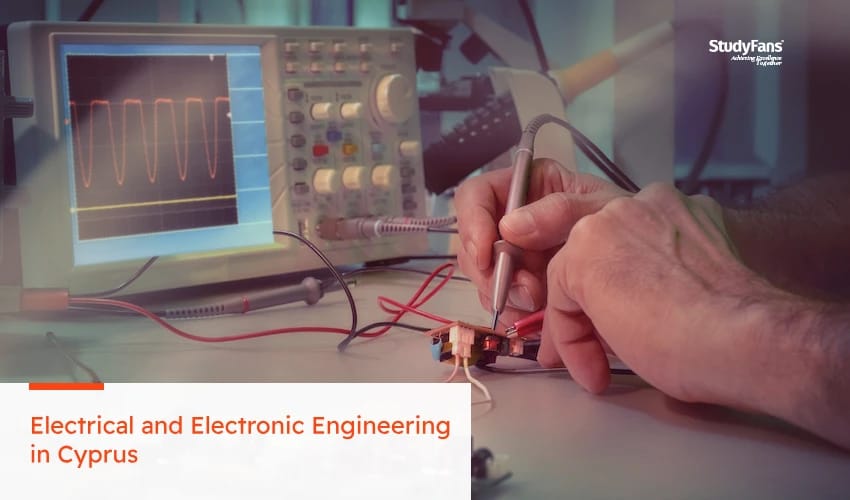

Electrical and Electronic Engineering in Cyprus is a dynamic field shaping modern technology, from power systems to robotics and telecommunications. Cyprus provides high-quality education, practical training, and research opportunities, making it an excellent choice for students pursuing a successful engineering career.
Overview of Electrical and Electronic Engineering
Electrical and Electronic Engineering (EEE) is a branch of engineering that focuses on the study and application of electricity, electronics, and electromagnetism in various practical fields.
Electrical engineering represents the broader domain, encompassing the generation, transmission, and management of power, while the electronic aspect focuses on designing and developing circuits, devices, and systems such as transistors and integrated circuits. This field has been practiced since the 19th century and is a pioneer of modern technologies across vital sectors, including transportation, healthcare, construction, and robotics, making it a cornerstone of contemporary technological advancement.
Thanks to a strong foundation in physics, mathematics, and technological problem-solving skills, electrical and electronic engineers are at the forefront of developing modern technologies that drive industries and enhance our daily lives.
Why Study Electrical and Electronic Engineering in Cyprus?
Studying Electrical and Electronic Engineering in Cypriot universities provides students with a strong academic foundation and practical skills in a supportive, internationally oriented environment. Below are some key reasons that make Cyprus an excellent choice for this field.
1- High Quality of Education
Universities in Cyprus are renowned for providing high-quality engineering education supported by modern curricula, advanced laboratories, and experienced faculty members. These institutions follow the standards of the Accreditation Board for Engineering and Technology (ABET), ensuring that students gain the practical skills and technical knowledge required to compete in the global job market.
2- Cultural Diversity
Studying in Turkish Cyprus offers a multicultural learning environment, where students from diverse backgrounds and nationalities come together. This diversity enriches the educational experience and promotes cultural exchange, helping students develop adaptability, intercultural communication skills, and global awareness, all essential qualities for professional success in today’s interconnected world.
3- Affordable Tuition Fees
Universities in Northern Cyprus offer an economically attractive option for studying Electrical and Electronic Engineering compared to many other countries.
4- Scholarships and Financial Support
Many universities in Cyprus provide scholarships and financial aid programs to support talented and dedicated students. These opportunities significantly reduce financial stress while encouraging academic excellence.
5- Practical Experience and Industry Connections
Beyond academic learning, universities in Northern Cyprus offer valuable opportunities for internships and collaboration with industrial partners. Such experiences help students gain practical insight into real-world applications, build professional networks, and transition from academic study to the job market with confidence and competence.
Top Universities to Study Electrical and Electronic Engineering in Cyprus
Many prestigious universities in Northern Cyprus offer Electrical and Electronic Engineering programs based on the latest technologies and modern academic standards, including:
Eastern Mediterranean University
The Department of Electrical and Electronic Engineering at EMU offers a Bachelor’s program accredited by the Accreditation Board for Engineering and Technology (ABET), providing education in modern laboratories equipped with the latest educational technologies.
Middle East Technical University (Northern Cyprus Campus)
The Electrical and Electronic Engineering (EEE) program at METU NCC provides contemporary education that equips students with research and leadership skills, preparing them for engineering careers both locally and internationally.
Bahçeşehir Cyprus University (BAU Cyprus)
The Department of Electrical and Electronic Engineering at BAU Cyprus provides students with a comprehensive curriculum designed to develop their skills and shape them into successful engineers, within a practical and hands-on learning environment, to get a Bachelor's degree.
European University of Lefke (EUL)
The Electrical and Electronic Engineering (EEE) program at EUL University provides a solid foundation in electrical and electronic theories, complemented by hands-on experiences in the university’s laboratories and a thorough understanding of fundamental principles. The department aims to cultivate competent and creative engineers through high-quality collaborations with universities and industrial sectors in Turkey and the United Kingdom.
Near East University (NEU)
The Department of Electrical and Electronic Engineering at Near East University was established in 1990, supported by advanced laboratories in electricity, electronics, communications, and intelligent systems.
The department aims to graduate engineers with strong scientific and practical foundations, capable of innovation and professional responsibility, while promoting lifelong learning.
It stands out for its young academic staff, strong research base, and modern laboratories that enhance the quality of education and training.
University of Kyrenia
The Department of Electrical and Electronic Engineering strives to offer advanced engineering education with a strong focus on high-quality academic and practical training, guided by a team of specialized academics and supported by modern, well-equipped facilities. The department aims to achieve excellence in education and research while strengthening its competitiveness both locally and internationally.
Also Read: The best Turkish universities in Cyprus
Programs of study in Electrical and Electronic Engineering in Cyprus
Electrical and Electronic Engineering study programmes at universities in North Cyprus combine in-depth theory with advanced practical application. Here is an overview of the most prominent courses included in this major at Cypriot universities:
General Chemistry
Physics
Calculus
Programming
Introduction to Electrical and Electronic Engineering
Algorithms and Data Structures
Differential Equations
Circuit Theory
Fundamentals of Thermodynamics
Mathematical Methods for Engineers
Material Science
Physical Electronics
Electromagnetics
Electronics
Electromechanical Energy Conversion
Introduction to Logic Design
Fundamentals of Engineering Economy
Ethics in Engineering
Digital Signal Processing
Microcontroller Applications
Electromechanical Energy Conversion
Signals and Systems
Admission Requirements For Electrical and Electronic Engineering in Cyprus
To be admitted to Electrical and Electronic Engineering programs, international applicants must hold a qualification equivalent to a high school diploma with a strong background in Mathematics and Physics, as these are the core subjects of the field. The accepted qualifications include:
GCE Certificate: At least 2 A-Level subjects or equivalent in Mathematics and Physics.
SAT: A minimum total score of 900, with at least 450 in Mathematics.
IB (International Baccalaureate): A minimum overall score of 26 out of 42.
ABITUR: A maximum grade of 3.5.
WAEC (West African Examination Council): Successful completion of 5 subjects, including English, Mathematics, and Physics, with a maximum total of 25 points and a minimum grade of C.
English Proficiency Requirement:
All applicants whose first language is not English must demonstrate their language proficiency either by passing the university’s approved English proficiency test (TOEFL, or IELTS) or by submitting an official certificate that verifies their level of English competence.
Required Documents for Undergraduate Application:
A certified copy of the high school diploma or its equivalent, along with a transcript of grades.
A recent passport-sized photograph.
A copy of the passport (information page) or birth certificate.
Proof of English language proficiency, if available.
Note: All documents must be accompanied by official English translations.
Also Read: Admission requirements to study in Cyprus
Cost of Studying Electrical and Electronic Engineering in Cyprus
Studying electrical and electronics engineering in Cypriot universities is a great option for international students seeking high-quality education at a reasonable cost compared to other European countries. Tuition fees vary depending on the university and the program the student enrolls in.
Here are the tuition fees for electrical and electronics engineering programs at some universities:
University | Annual tuition fees |
€5600 | |
Eastern Mediterranean University | $5,605 |
$5600 | |
Bahçeşehir Cyprus University (BAU Cyprus) | $7,140.00 |
Middle East Technical University (Northern Cyprus Campus) | $9450 |
Required Skills for Electrical and Electronic Engineering Students
Students in Electrical and Electronic Engineering need a combination of technical, analytical, and practical skills that enable them to understand electrical systems and design innovative solutions. The most important skills include:
Technical skills: Understanding electrical and electronic circuits, using measurement and simulation tools, and working with programming and embedded systems.
Analytical and problem-solving skills: The ability to analyze complex problems and develop precise and effective engineering solutions.
Programming skills: Proficiency in common programming languages for system design and control.
Design skills: Designing electrical and electronic circuits using engineering software.
Teamwork and communication: Collaborating with multidisciplinary teams and effectively communicating technical ideas.
Time and project management: Organizing tasks and meeting project deadlines efficiently.
Creativity and innovation: Thinking creatively to develop new technologies and enhance existing systems.
Continuous learning: Keeping up with advancements in technology, energy, and communications to stay current with industry trends.
Learning Outcomes of the Electrical and Electronic Engineering Program
Mastery of fundamental concepts in mathematics, physics, and electrical and electronic engineering.
Ability to analyze complex engineering problems and develop innovative, practical solutions.
Competence in designing electrical and electronic systems and devices that meet standards of safety, sustainability, and quality.
Effective use of modern technologies, modeling, and simulation tools.
Application of the scientific method to design, conduct experiments, and analyze data for accurate results.
Capability to work efficiently within multidisciplinary teams and independently when required.
Clear and professional oral and written communication in English.
Commitment to professional ethics and social responsibility in engineering practices.
Awareness of the importance of lifelong learning and keeping up with technological and scientific advancements.
Understanding of project management, entrepreneurship, and sustainable development principles in engineering.
Career Fields for Electrical and Electronic Engineering Graduates
Graduates with a Bachelor’s degree in Electrical and Electronic Engineering enjoy a wide range of career opportunities in both public and private sectors, where they can apply their technical and analytical skills across different industries. Career paths include:
Government institutions such as ministries, municipalities, universities, and research centers.
Public sector organizations involved in production, infrastructure, and energy development.
Private companies specializing in electrical and electronic system design, automation, telecommunications, and manufacturing.
Entrepreneurship, where graduates can establish their own startups or engineering consultancies.
Research and innovation centers, contributing to technological advancements and sustainable solutions.
Conclusion
Studying Electrical and Electronic Engineering in Cyprus offers an exceptional opportunity to gain a solid scientific foundation combined with practical experience in a modern, multicultural academic environment. This program opens wide career prospects in fields such as energy, communications, and smart systems, preparing graduates to compete confidently in the global job market.
If you’re planning to pursue this major, the StudyFans team can help you secure admission to the top universities in Northern Cyprus easily and with full guidance.
If you wanted to know more or have any questions, we are here to help you and you can always contact us:
Phone: 00905437394024
Or via WhatsApp through this link.


![The Top 10 Universities in Türkiye [Worldwide Ranking]](/_next/image?url=https%3A%2F%2Fbackend.studyfans.com%2Fstorage%2Fmedia%2FPostTranslations%2Fimage%2F882%2FE7WXOQMpNbUZMo5P8Bjvt5WqhQPkmpvd2ajkM1JQ.webp&w=1080&q=75)
